The short answer
- Most wet Maine basements come from groundwater, not plumbing: dense hardpan till, Presumpscot marine clay and shallow ledge keep water sitting against the foundation instead of draining away.
- Maine is getting wetter. Annual precipitation is up about 6 inches since 1895, with roughly 10 to 15 more heavy-precipitation events a year than in the previous century.
- About 22% of Maine homes were built before 1940, roughly double the national share, and old fieldstone and rubble foundations were never built to keep water out.
- Sealing the inside of the wall rarely works for long. The reliable fix is to manage the water: grading and gutters outside, and an interior drain at the footer that carries water to a sump pump.
On this page
- Why does my basement get wet in Maine?
- Southern Maine soil: Presumpscot clay, hardpan and ledge
- High water table and hydrostatic pressure, explained
- Is Maine getting wetter?
- Why old Maine houses have wet basements
- Why basements leak in spring (and after big storms)
- How to tell which problem you have
- What actually fixes a wet basement in Maine
If you are asking why Maine basements get wet, the short version is that a lot of us live on ground that holds water, in houses that were built before anyone expected a basement to stay dry, in a climate that is getting wetter. Each of those is a separate problem. Put them together and you get the damp corner, the puddle at the base of the stairs, or the inch of water that shows up every April.
We work in basements from Kittery to Brunswick and out to the Lewiston and Sebago Lakes area, and the same handful of causes come up again and again. Here's how each one works, in plain terms.
Why does my basement get wet in Maine?
Almost every wet basement we look at comes down to one of three water sources:
- Groundwater. Water in the soil around and under the house rises during wet periods and pushes in at the wall-floor joint, through cracks, and up through the slab. This is the big one in Maine.
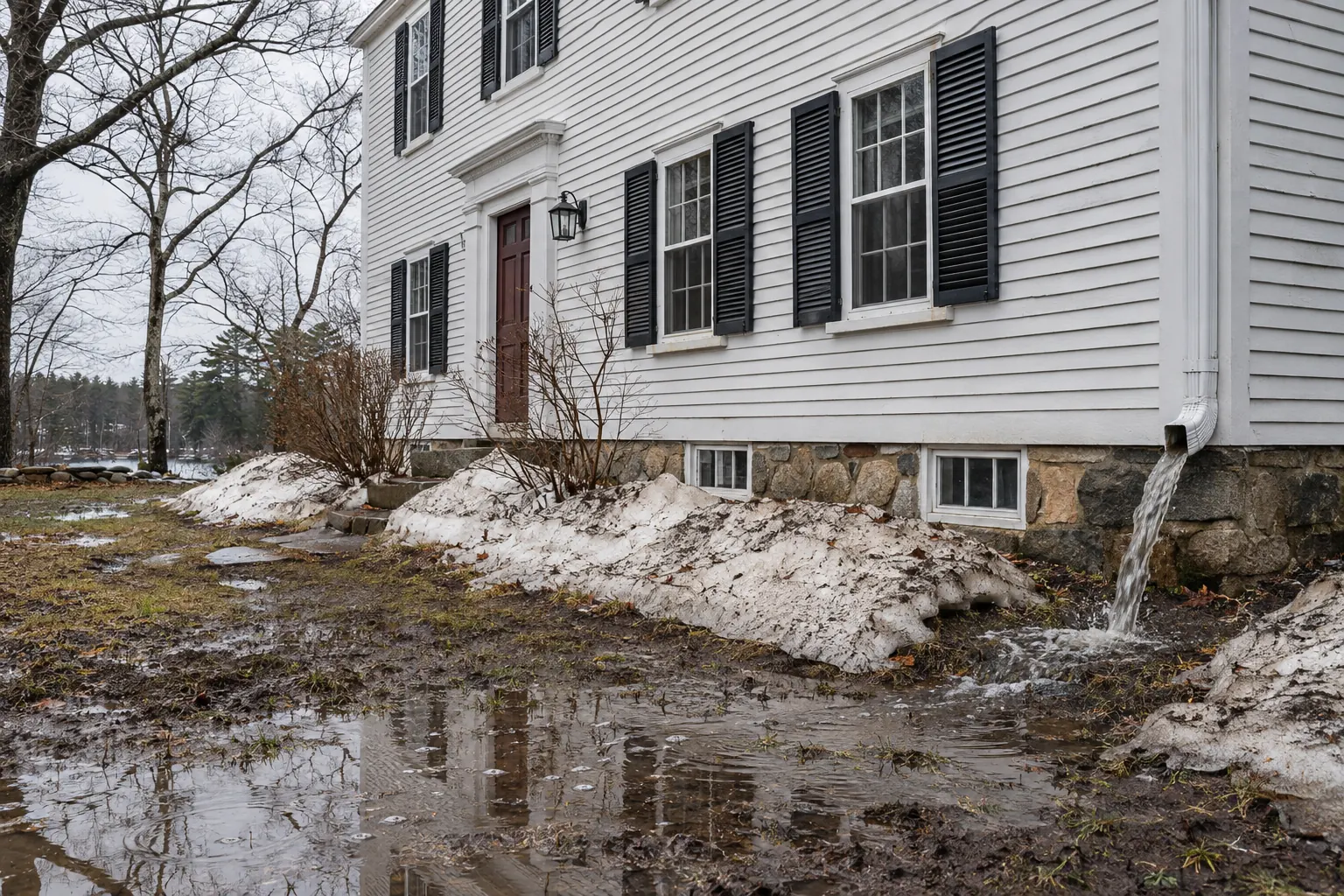
- Surface water. Roof runoff, short downspouts and grading that slopes toward the house dump water right against the foundation.
- Moisture from inside. Condensation on cold walls and pipes in summer can look like a leak. It is a humidity problem, not a water-entry problem, and the fix is different. Here's how to tell a basement leak from condensation.
When water shows up after rain or snowmelt and goes away in dry weather, you are dealing with groundwater or surface water. What makes Maine different is how much of that water has nowhere to go.
Southern Maine soil: Presumpscot clay, hardpan and ledge
The ground under most southern Maine homes was shaped by glaciers, and very little of it drains like a sandy beach. Three soil and rock conditions do most of the damage.
Presumpscot clay
When the last ice sheet melted back, the land was pressed down so far by the weight of the ice that the ocean flooded the Maine coast. Fine silt and clay washing off the glaciers settled on that seafloor. When the land rebounded, it left a blanket of glacial-marine mud across the coastal lowlands. The Maine Geological Survey calls it the Presumpscot Formation, named for the Presumpscot River valley in Portland and Westbrook.
The USGS describes it as marine silty clay that ranges from nothing to about 110 feet thick and changes rapidly over short distances. That last part matters for homeowners: two houses on the same street can sit on very different ground. Clay drains slowly, so rain and snowmelt that land on it tend to stay near the surface and collect along foundation walls. The Maine Geological Survey notes that clay areas tend to be wetter, with more swampy ground.
Hardpan till
Away from the clay, a lot of Maine sits on glacial till, a mix of everything the ice dragged along. The densest kind was packed down under moving ice, and Mainers have called it "hardpan" for generations. The Maine Geological Survey describes basal till as fine-grained and very compact, with low permeability and poor drainage. Dig a foundation hole in hardpan and you have essentially dug a bowl. Water runs down along the loose backfill next to the wall, hits the hardpan, and sits there against your footer.
Ledge
Then there is ledge. The Maine Geological Survey says depth to bedrock in Maine is generally only a few tens of feet and rarely more than a hundred, and in plenty of neighborhoods it is a lot closer than that. The USGS describes our aquifers as thin sediments sitting on crystalline bedrock with relatively little storage. Water that soaks in cannot go far down, so it moves sideways, and a basement is often the lowest, easiest place for it to go.
High water table and hydrostatic pressure, explained
The water table is the level below which the soil is saturated. In Maine it moves with the seasons. The USGS notes that spring snowmelt is the key recharge period for groundwater in northern New England, after which groundwater slowly drains toward streams through the summer. So the water table around your house is typically highest in spring and after long wet stretches, and lowest in late summer and fall.
When the water table rises above the level of your basement floor, the soil around the foundation is full of water, and that water pushes. That push is hydrostatic pressure. Water weighs about 62.4 pounds per cubic foot, according to the USGS. Every foot of water standing against the wall adds roughly another 62 pounds of pressure on each square foot of wall and floor below it. Concrete is porous, mortar joints wear out, and there is a seam where the floor meets the wall. Under pressure, water finds all of them.
This is also why the wall-floor joint is the most common place we see water come in. The footer, the wider concrete base the wall sits on, is usually the lowest point of the foundation, and water collects there first.
Is Maine getting wetter?
Yes, and the numbers are not subtle. According to the Maine Climate Office at UMaine, summarizing Maine Climate Council findings, average annual precipitation in Maine has risen by about 6 inches since 1895. Maine now sees roughly 10 to 15 more heavy-precipitation events a year than in the previous century.
The Maine Climate Council's 2024 scientific assessment reports that Maine now gets one to two more days a year with 2 or more inches of precipitation, and two to three more days a year with at least an inch. Those big days are what overwhelm gutters, saturate the backfill around a foundation and push the water table up fast.
Here in Greater Portland, the 1991 to 2020 normals for Portland Jetport show 48.12 inches of precipitation a year, with about 12 days a year that bring an inch or more. October is the wettest month on average, at 5.25 inches, so fall storms matter as much as spring.
Warmer winters add to it. The Maine Climate Office reports that Maine's average annual temperature has risen about 3 degrees F over the past century and winter is about two weeks shorter than in the early 1900s. In practice, more winter precipitation can arrive as rain, often on frozen or snow-covered ground that cannot absorb it.
Why old Maine houses have wet basements
Maine does not have the oldest median housing in the country, but it does have an unusually large share of very old homes. In the Census Bureau's 2024 American Community Survey, about 22.4% of Maine's housing units were built in 1939 or earlier, compared with 11.5% nationally. Only a handful of states have a higher share.
Locally, the share is even higher in places. In Cumberland County it is about 24.4%, in York County about 20.1%, and in the city of Portland about 47% of homes were built before 1940.
Houses from that era were not built with modern footing drains, damp-proofing or a sump. Many have fieldstone, granite block or rubble foundations, laid dry or with lime mortar that has been washing out for a century. Building Science Corporation, a leading building-science firm, puts it bluntly in its guide to rubble foundations: "Unless you are very, very lucky almost all rubble foundations leak and are damp." We cover old stone walls in more detail in waterproofing a fieldstone foundation in Maine.
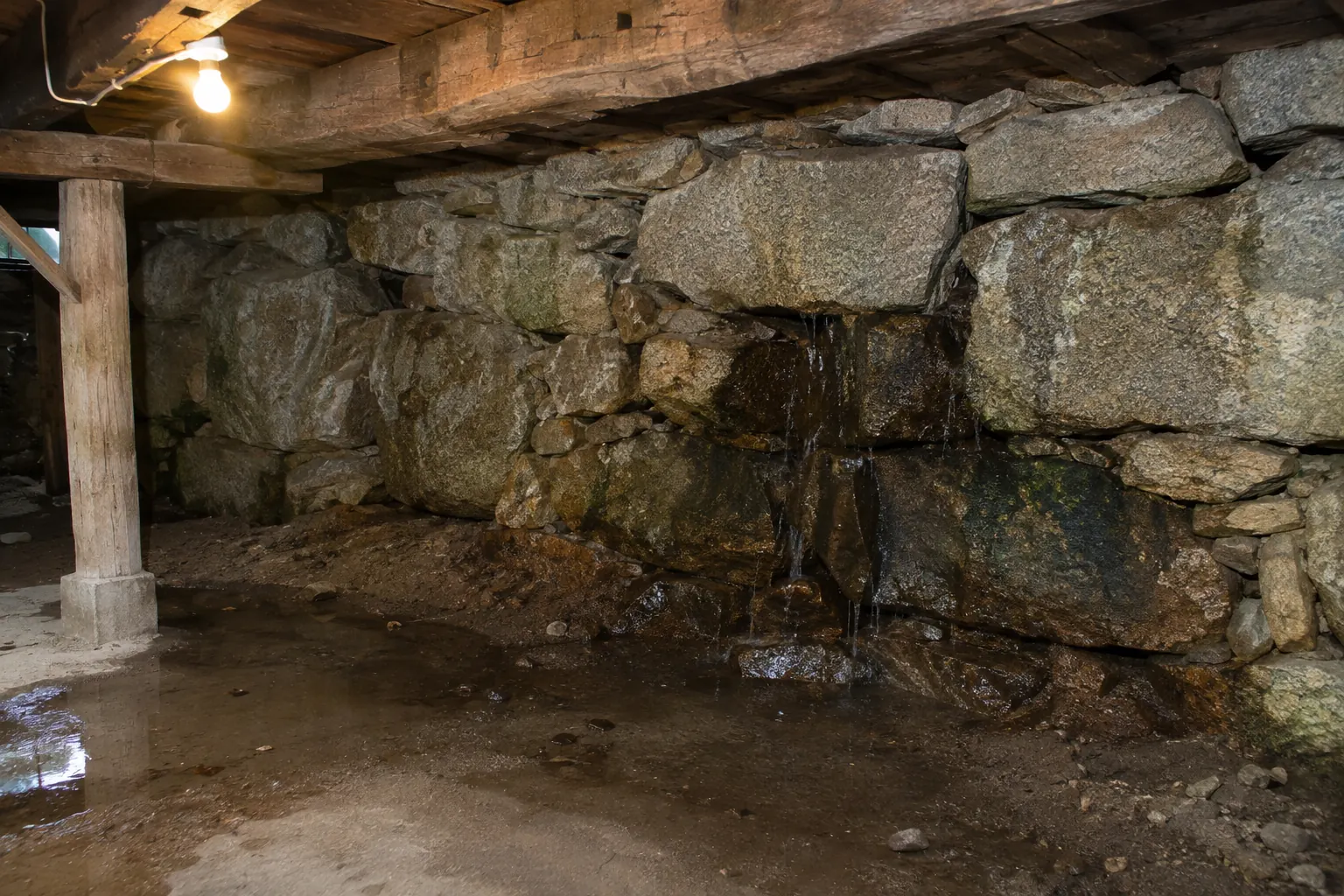
Newer poured-concrete basements are not immune either. Shrinkage cracks, form-tie holes and pipe penetrations all give water under pressure a way in.
Why basements leak in spring (and after big storms)
Spring in Maine piles every factor on at once. The snowpack melts. Rain falls on ground that may still be frozen a few inches down, so it runs off toward the lowest spot instead of soaking in. The water table is recharging. If your basement is going to leak, March and April are when it usually happens. Our spring thaw basement flooding guide covers how to get ready.
Big coastal storms bring their own trouble. On January 13, 2024, the Portland tide gauge reached 14.57 feet, breaking a record that had stood since 1978, according to the National Weather Service in Gray. Coastal flooding like that is a different problem from groundwater seepage, but it is a reminder that homes near the water in Cape Elizabeth, Scarborough, Saco and Kennebunk face pressure from more than one direction. If you are wondering what your policy does with either kind of water, our post on whether homeowners insurance covers a wet basement in Maine goes through it.
How to tell which problem you have
Before you spend money, it helps to know which kind of water you are dealing with. A few things to check:
- Where it shows up. Water along the wall-floor joint or rising through floor cracks points to groundwater. Water running down the face of one wall under a downspout points to surface water.
- When it shows up. Only after heavy rain or snowmelt suggests groundwater or runoff. A wet wall on a humid August day with no rain suggests condensation.
- White, chalky residue. That is efflorescence, mineral salts left behind as water moves through concrete or mortar and evaporates. It means water has been coming through, even if the wall is dry today.
- Outside the house. Look for downspouts that empty at the foundation, gutters that overflow, and soil or a patio that slopes toward the house.
What actually fixes a wet basement in Maine
Because so much of Maine's basement water is groundwater under pressure, the fixes that last are the ones that give that water a controlled path out instead of trying to block it.
Interior perimeter drainage
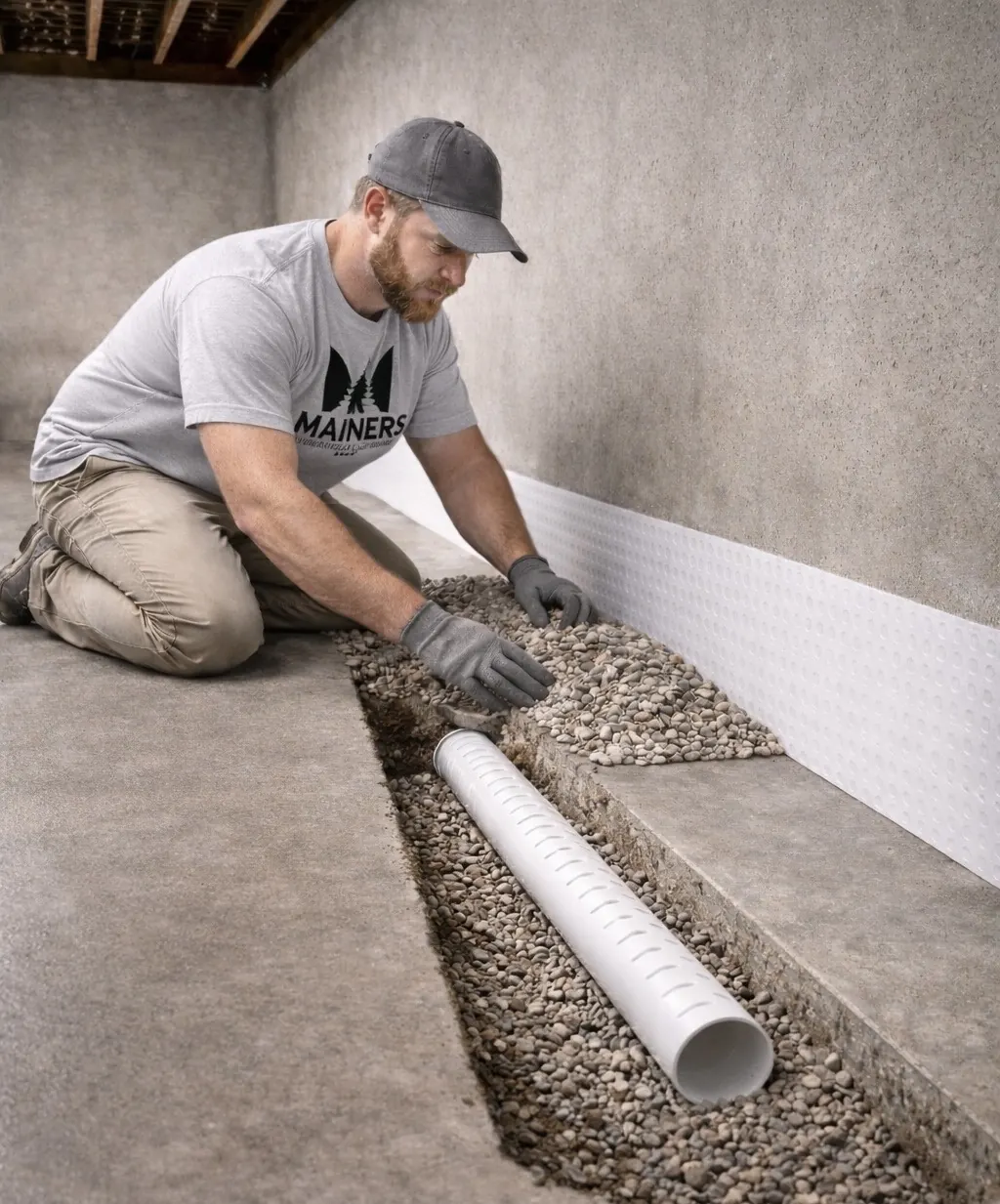
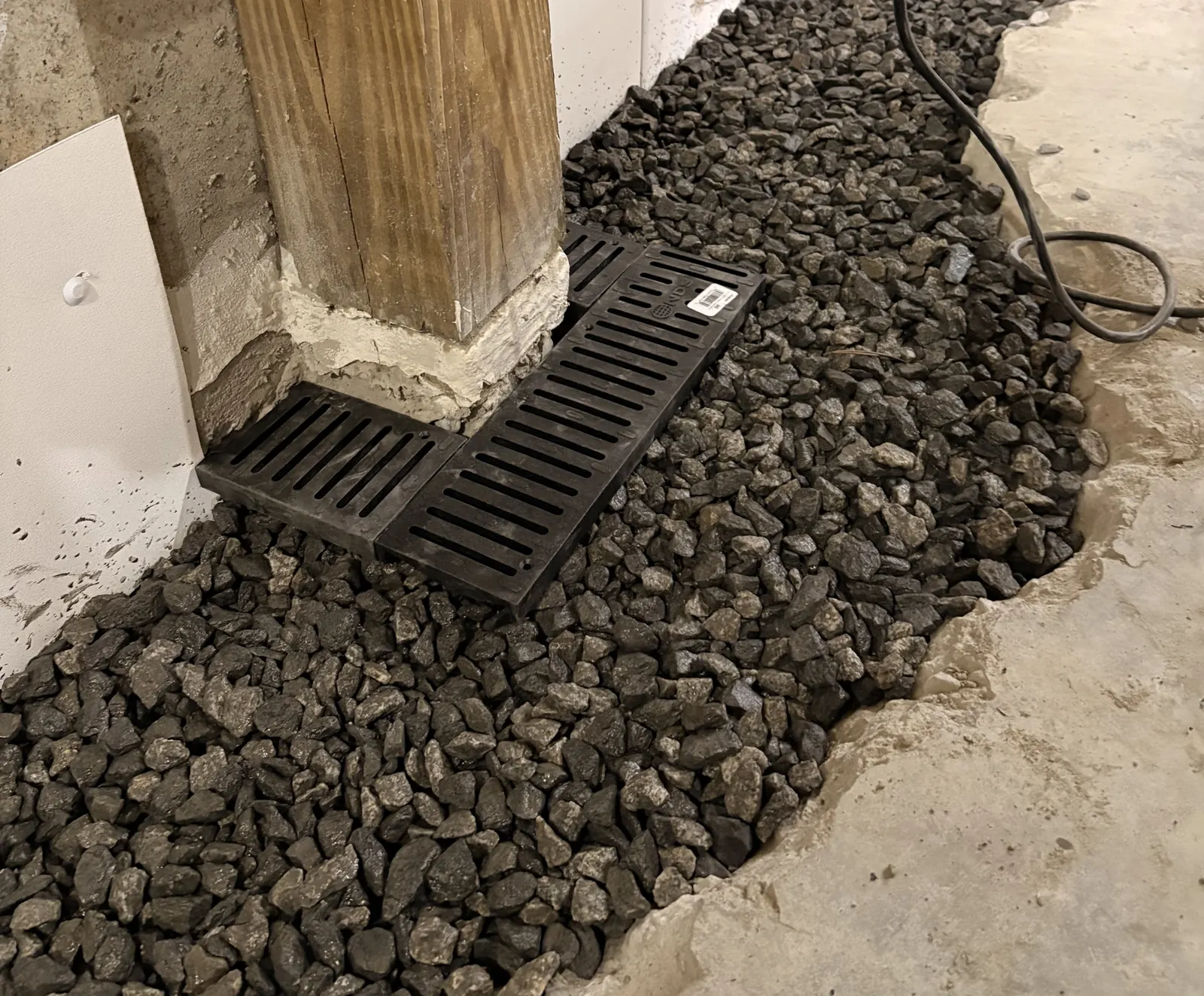
An interior perimeter drain is installed around part or all of the inside edge of the basement. We open a strip of the floor along the wall, dig down beside the footer, set a 4-inch drain pipe in stone, and route it to a sump basin where a pump sends the water outside. Then the concrete goes back.
"Where we put the drain pipe is one of the biggest differences in our approach."
Ben, owner of Mainers
When site conditions allow, Ben's crews set the pipe beside the footer and below its top, so groundwater is collected at the lowest point before it reaches the slab edge. If you are comparing proposals, our guide to interior basement drainage systems and why pipe placement matters explains what to ask. You can also see how we approach it on our basement drainage page.
Building Science Corporation recommends the same basic strategy for leaky rubble foundations: the wall may keep leaking, but the water is collected on the inside and sent back outside. On old stone walls that is usually far more realistic than trying to make the stone watertight.
The sump pump, and what keeps it running
An interior drain is only as good as the pump at the end of it. That means a properly sized pump, a check valve, a discharge line that carries water away from the house, and a plan for the two things that take Maine sumps out: frozen discharge lines in winter and long power outages after storms. We cover those in how to keep a sump pump discharge line from freezing and battery backup sump pumps for Maine power outages. Our sump pump installation page covers new pumps, Zoeller options, battery backups and high water alarms.
Wall cracks and radon
Cracks that are actively leaking can be addressed as part of a basement waterproofing plan. And because many Maine homes also have elevated radon, we can set up the drain and a sealed sump so they work with a radon system rather than against it. Radon testing and mitigation itself should be done by a Maine-registered radon professional; more in radon and basement waterproofing in Maine.
A little dampness in a 150-year-old cellar may be something you manage with a dehumidifier. Water every spring, equipment sitting in the wet area, or plans to finish the space are good reasons to get a professional opinion.
Mainers is a family-owned basement waterproofing company in Scarborough, serving southern, coastal and inland Maine and select New Hampshire towns. Ben does the estimates himself, and he will explain where your water is coming from and what it would take to manage it. If you already have a quote from another reputable, insured company, we are glad to compare it. Request a free in-home estimate or call (207) 205-2250, any day from 7 AM to 7 PM.
Questions Maine homeowners ask us
Is it normal for a Maine basement to get wet?
It is common, especially in older homes and in towns sitting on clay or dense till, but common is not the same as harmless. Repeated water brings humidity, musty smells, rust on equipment and damage to anything stored down cellar. If water shows up every spring or after every big rain, it is worth finding the path it takes.
Why does my basement only leak in the spring?
In Maine, spring stacks the deck: the snowpack melts, rain falls on ground that is often still frozen near the surface, and the water table rises as aquifers recharge. Water that cannot soak in or drain away collects against the foundation and finds the wall-floor joint, cracks and old mortar joints.
Does Presumpscot clay cause basement water problems?
The clay itself does not create water, but it drains poorly. Rain and snowmelt that land on clay soils tend to stay near the surface and pond along the foundation, so homes on these soils often see more water against the walls during wet periods. A drainage plan has to account for that slow-draining soil.
Can I just seal my basement walls from the inside?
Coatings can help with dampness on sound concrete, but they do not stop water under pressure, and on fieldstone or rubble walls they rarely last. Building science guidance for old stone foundations is to collect the water that gets through and pump it out, not to try to dam it. See our basement drainage page for how that works.
What is hydrostatic pressure in a basement?
It is the push that water in saturated soil puts on your foundation walls and floor. Water weighs about 62.4 pounds per cubic foot, so the deeper the water stands against the wall, the harder it pushes into cracks, joints and porous concrete.

Ben grew up in southern Maine and runs Mainers Basement Company, a family-owned basement waterproofing company in Scarborough. He still does estimates and works on job sites alongside the crew, and the team brings more than 60 years of combined experience with Maine basements. More about Mainers.
Sources
- Climate Change in Maine (summary of Maine Climate Council and Maine's Climate Future findings), Maine Climate Office, University of Maine
- Scientific Assessment of Climate Change and Its Effects in Maine: 2024 Update, Executive Summary, Maine Climate Council Scientific and Technical Subcommittee
- Summary of Monthly Normals 1991-2020, Portland International Jetport, NOAA National Centers for Environmental Information / NWS Gray
- Geolex: Presumpscot Formation, U.S. Geological Survey, National Geologic Map Database
- Presumpscot Formation clay map and fossils, Maine Geological Survey
- Reading Surficial Geology Maps (till, hardpan and drainage), Maine Geological Survey
- Reading Surficial Materials Maps (depth to bedrock), Maine Geological Survey
- Quantifying effects of climate change on snowmelt-dominated groundwater resources in northern New England, U.S. Geological Survey
- Facts About Water, U.S. Geological Survey Water Science School
- Table B25034: Year Structure Built (ACS 2024 1-year, Maine, Cumberland County, York County, Portland, United States), U.S. Census Bureau via Census Reporter
- BSI-041: Rubble Foundations, Building Science Corporation
- Portland record tide, January 13, 2024, National Weather Service, Gray, ME
This article is general information for Maine homeowners. Every basement is different; an on-site inspection is the only way to know what yours needs.